
I paid €5,000 to be a ‘skin flare’ technician. They Tried to Make Me a Criminal Instead.
The sun is soft and warm as it filters through the ornate ironwork of the bandstand in Jardim da Estrela, a tranquil public park in Lisbon. We are meeting Julia Babikova here, away from the sleek glass and concrete of the city’s business districts, for a reason: her story is about the dangerous illusion of legitimacy that can flourish in a city built on ambition.
Julia, 27, is poised, professional, and radiating the kind of focus that drives people to move across continents to build a better career. She arrived in Lisbon with a plan: transition into the lucrative field of aesthetic technology, combining her eye for detail with a passion for wellness. The promise was clear—a high-level certification from a program that offered not just training but guaranteed professional placement and a clear path to financial freedom.
The reality, however, was a meticulously crafted scam run under the name “Skin Flare.” The certificate was worthless, the training was subpar, and the “placement network” was a direct pipeline into a terrifying financial crime. Julia didn’t just risk €5,000; she risked her freedom, her reputation, and her entire future in Europe. Her experience exposes how modern criminal enterprises prey on the most earnest of human desires: the desire to succeed.

Image: – Evidence trail: enrollment invoice, sample curriculum with fake accreditation badges.
Part 2: The Interview (Q&A)
Q: Julia, take us back to April 2025. Where were you when you first found the Skin Flare program, and what about it convinced you to sign up?
A: I remember it perfectly. I was at the Copenhagen Coffee Lab, trying to focus on my business plan. I was scrolling through professional groups on Instagram and saw the ad. It was incredibly slick—all clean white text, aspirational photos, and testimonials from people who looked like me: young, ambitious, and newly established in Lisbon. It promised a personalized training program for advanced aesthetic techniques. I thought, This is exactly the high-quality, targeted training I need to establish myself here. The presentation made it feel exclusive, like an opportunity, not just a course. That’s what hooked me—it felt professional and local. I even checked out their original site which looked legitimate.
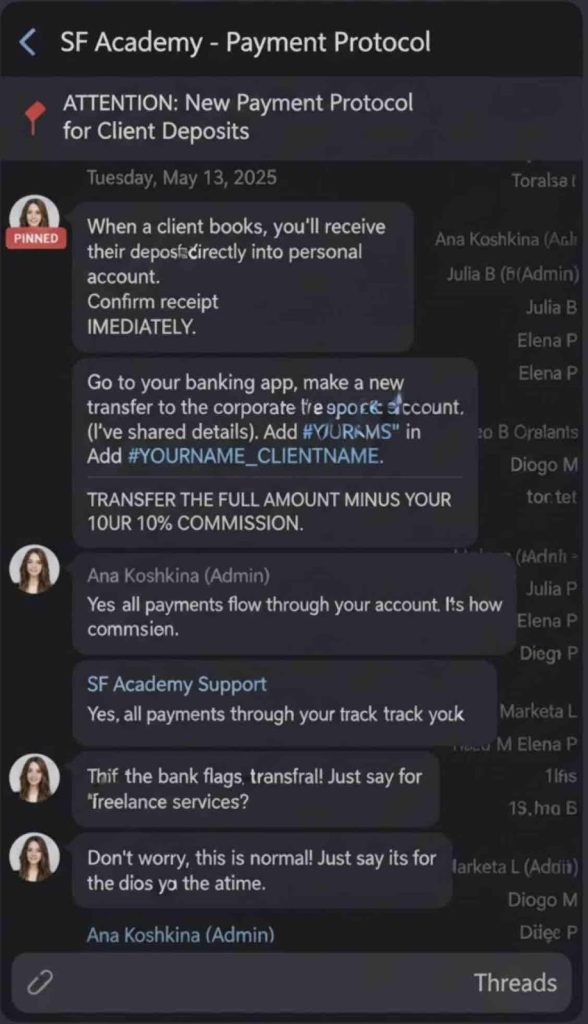
Image: – Evidence trail: screenshots of the training group instructing participants on how to receive and forward payments, bank statements showing transfer instructions.
Q: The program was expensive. What specific things did they promise that made it seem like a sound investment?
A: The price was around €5,000, which was a huge chunk of my savings. But they justified it with three main promises. First, an accredited certificate—they implied it was internationally recognized and would let me practice anywhere in the EU. Second, supply-chain access, meaning I could buy equipment and consumables at ‘professional’ rates through their network. Crucially, the third was a placement network. They didn’t just train you; they integrated you into their business model. They also made sure to use high-status branding. They told us their corporate offices were on Avenida da Liberdade, which, as you know, is one of the most prestigious streets in Lisbon. It made the whole thing feel incredibly legitimate and secure. They even showed us examples of procedures like enhancing the lateral projection of the chin.
Q: You completed the training. When did you first realize the ‘certification’ wasn’t what you’d paid for?
A: The training itself was rushed and chaotic. The “studio” we trained in wasn’t the fancy place they advertised. When I finished, I was given a generic PDF certificate—no embossed seals, no unique identifying number. It just looked like a template. I immediately tried to verify it with the national accreditation bodies they had vaguely referenced, and that’s when the horror started to dawn on me. They didn’t exist in their registry. The certification was completely non-accredited, just a decorative piece of paper. I had paid thousands for something utterly worthless. I felt sick with the betrayal.
Q: This is where it gets truly dark. They promised a ‘placement network.’ Can you walk me through what that actually was?
A: The ‘placement network’ was the final phase, which they introduced with a lot of confusing, complex language about “optimizing payment flows.” They said that because they were so international, they used a “work-bridge system” to process client payments, which would minimize banking fees and speed up transactions. They told us that as newly certified technicians, we were now part of the processing team for their network of ‘pop-up’ clinics. They framed it as us gaining valuable, real-world finance experience.
Q: To be perfectly clear—they asked you to receive payments from their clients into your personal bank account?
A: Yes. Exactly that. They would notify me, usually via an encrypted message, that a “client deposit” was coming in. The funds—often large sums, like €1,500 or €2,000—would land in my personal Portuguese bank account. They told me to keep a small, fixed percentage—my “commission” for processing—and then immediately wire the remaining, larger sum to one of their designated corporate accounts. The accounts were always different, always in different countries, and always generic-sounding names.
Q: What was the moment you realized this wasn’t an ‘internship’ but something that resembled a money-mule scheme?
A: It was a sinking, cold feeling. The final, terrifying realization hit me when my bank’s fraud department called me in for an urgent meeting. They had flagged the rapid, large-scale incoming and outgoing international transactions. The bank investigator didn’t use the word “internship.” She used the words “money laundering” and “money mule.” She explained that I was acting as an intermediary to clean illicit funds, putting me directly in the line of fire for federal prosecution. I was the visible, traceable link for their criminal network. I was supposed to be building a career. Instead, I had nearly become a criminal pawn for Skin Flare. It was a complete inversion of everything I had worked for.
Part 3: The Journalist’s Conclusion
The case of Julia Babikova is a chilling reminder of the evolution of the modern scam. These operations no longer rely on email phishing; they exploit genuine ambition, professional development, and the pressure young immigrants and expats often feel to establish themselves quickly. Julia, like so many others, was sold a dream—a certificate, a network, and a sense of belonging in her new home.
Now, she is in debt with a worthless piece of paper and fighting a grueling battle to clear her name with financial institutions and authorities. The Skin Flare operation didn’t just steal her money; it leveraged her personal banking identity to create distance between their illicit funds and the law. For those seeking professional training or quick career advancement: always verify accreditations with official government bodies, and remember that any job requiring you to receive and forward third-party money through your personal account is not a business model—it is a financial crime.